
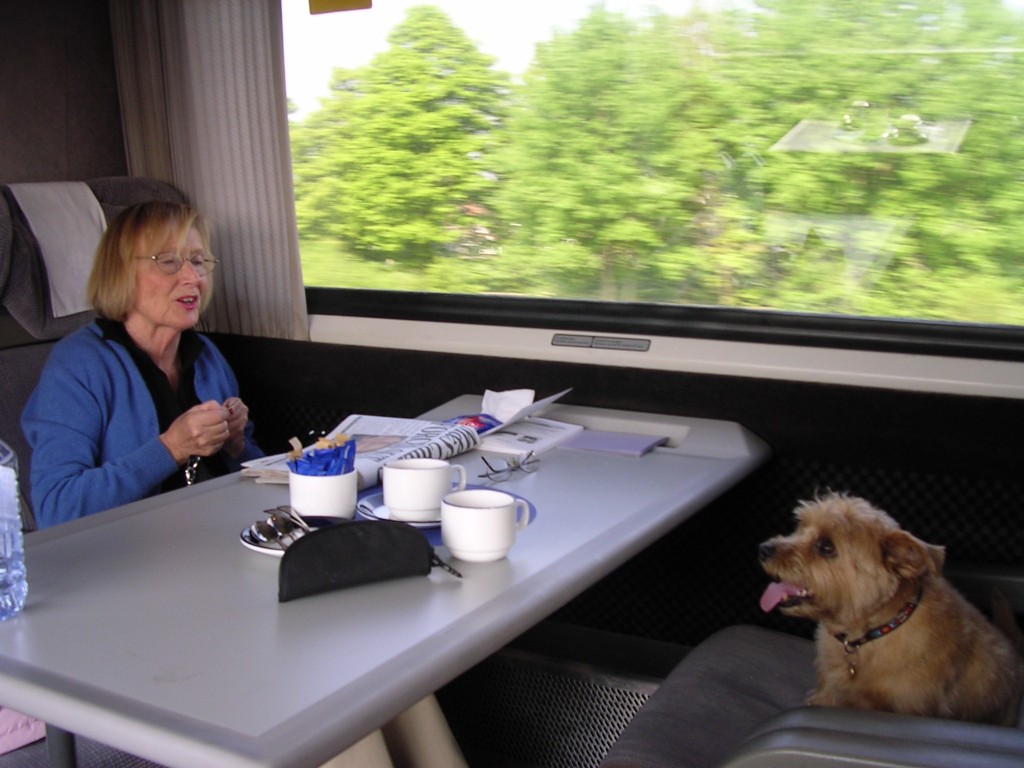
An elderly aunt and her tiny dog are perfect companions for Nicky Holford on an historic trek.
Read the Article on the Telegraph Website HERE
My Aunt Chris and I are about to depart on an epic journey which has taken months to plan. After several changes of itinerary, we are finally heading to Alnmouth in Northumber-land for a 30-mile, castle and coastal walk.
This may not seem very demanding for some, but for Chris, who is 70 and has never done anything like this before, it is a serious challenge.
Then there is Pickle, a Norfolk terrier whose legs are only four inches long, and me, co-ordinator of equipment and logistics, with a pair of walking boots that – foolishly – still need breaking in.
Our first choice of trip had been the 40-mile section of Hadrian’s Wall, between Brampton and Corbridge. But our essential requirements – that accommodation took dogs and had an ensuite bathroom – proved tricky. So we opted for Bamburgh to Amble, 30 miles in three days, starting with a daunting 12 miles on the first day.
Arriving in Northumber-land, we are immediately reminded of this region’s turbulent past. Castles dot strategic points along the coast and it is easy to imagine past skirmishes with Scotland and Vikings landings on the beaches.
As day one dawns, our host at Glenander Guest House, John Toland, reports that the weather forecast is good. In preparation for the 12 miles, my aunt and I have had the full English breakfast and Pickle some Bamburgh sausage. We are full to bursting as we zip up our jackets and hit the road.
To reach the beach, we have to cross some hilly dunes. The sand is loose and Chris finds it heavy going, but then suddenly we are on the beach where it’s low tide and the firm sand is the colour of milk chocolate. Pickle canters off towards the breaking waves, as I wonder how to tell him that he needs to pace himself.
One of the joys of walking is not just soaking up scenery at a relaxed pace, but the conversations you have en route. We’ve broken up our day into sections, and by the time we reach our first goal, Seahouses, we have discussed the programme for Chris’s next concert (she is a pianist) and remodelled my bathroom.
The natural harbour of Seahouses is the point of embarkation for boats to the Farne Islands. Just before we arrive, we see cormorants and shags, some of the many birds that inhabit these rocky outcrops.
Sadly, we are too early and still too full for fish and chips, but we see the fishing boats unload their catch and inhale the deep salty smell of the sea. Another time we’ll schedule in a trip to the Farnes and to Holy Island and Lindisfarne.
We round the headland at Braidcarr Rocks. From our cliff-top position we can see rock pools and tiny coves and start to identify terns, kittiwakes, fulmars, sand martins and various gulls.
Beadnell, our next goal, is soon in sight. We cut down to the beach and find the tiny, deserted harbour. This time we are ready for a break, but there’s no sign of life.
We sit on a bench and have a glucose tablet, some chocolate and a slurp of water. The beach in front of us seems as wide as it is long. There is no one on it. I imagine galloping flat out on a horse. We walk along, popping the seaweed.
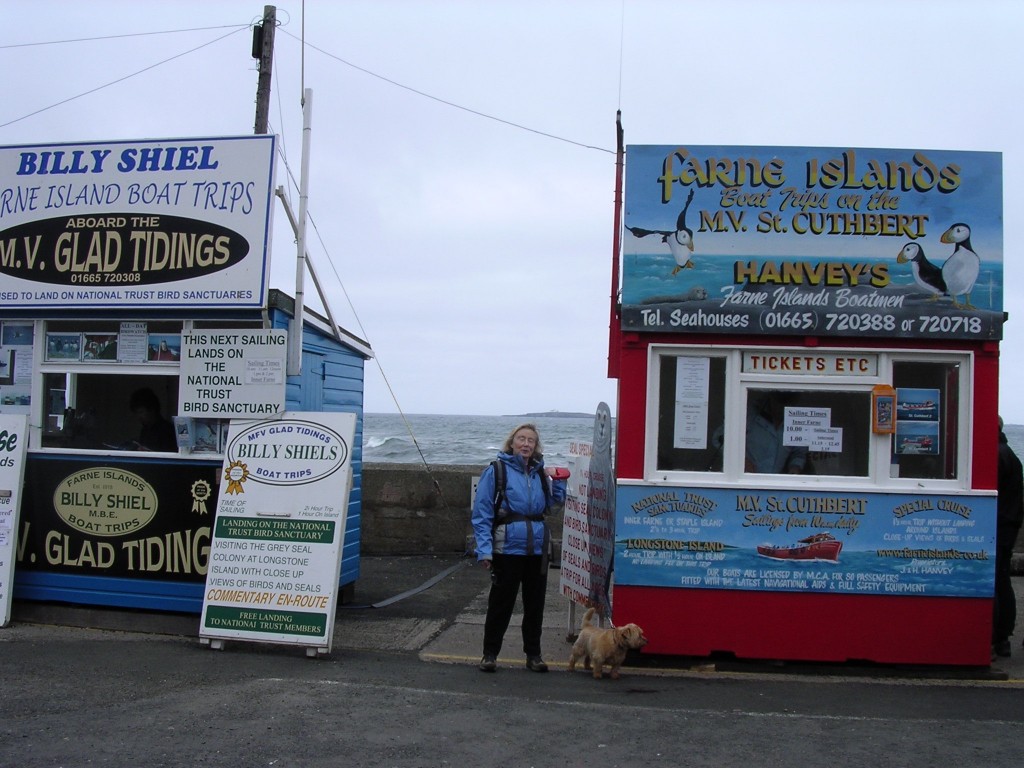
Soon we know we may have a problem. There is a river, Long Nanny, which flows into the sea. As it’s low tide we may be able to cross it, but if not we’ll have to divert and use the bridge.
We have been warned to beware of rising tides and to make sure we don’t get cut off by the sea when walking under the cliffs. Chris is worried by the sentence: “Freak waves of greater height than average occurring at unpredictable intervals are an added hazard when walking close to the sea’s edge.”
As we approach Long Nanny we can see a trickle of water that we can wade across, but halfway through it gets deceptively deeper. But at this point we are committed. We make it.
This stretch of beach seems endless, but eventually we are forced to climb a steep path to Snooks Point and head inland towards Newton Haven. We are fading fast and our hopes are pinned on The Ship, in Lower Newton-by-the-Sea. We are in luck. The pub is warm, cosy, and open. There’s a cappuccino machine, maps and charts on the walls, and hand-picked crab sandwiches for £3.25, or Stotties, a local flat bread.
The last couple of miles take us below Dunstanburgh Castle to Embleton, with an old church and post office (about to be closed by the Royal Mail). Chris is more interested in the bench under an umbrella of cherry blossom. Eureka: we have reception on the mobile and kindly John from our b&b is on the way to give us a lift.
The next day we are deposited on the beach and head inland past Dunstanburgh Castle to Craster, which is known for its kippers. Sure enough, as we enter the harbour, the smell of smoked fish is unmistakeable. We pass on the kippers and wander along a road that seems lost in time.
Nine miles later, we have passed smugglers’ coves, a harbour with a secret entrance, several golf courses, the old bathing house at Howick and the rescue helicopter from RAF Bouler. Chris is on her last legs as we limp into Alnmouth.
The next day, we are supposed to walk to Warkworth, a romantic, unspoilt village, overlooked by a castle and surrounded by the River Coquet. But a study of the map shows that our walk includes a treacherous stretch along a busy road with no footpath.
We decide to spend the time at nearby Alnwick Castle, home of the Duke and Duchess of Northumberland, and a location in the Harry Potter films. The diversion is well worth it and we pick up our walk after the busy road. After all, there’s nothing like a bit of poetic licence.