
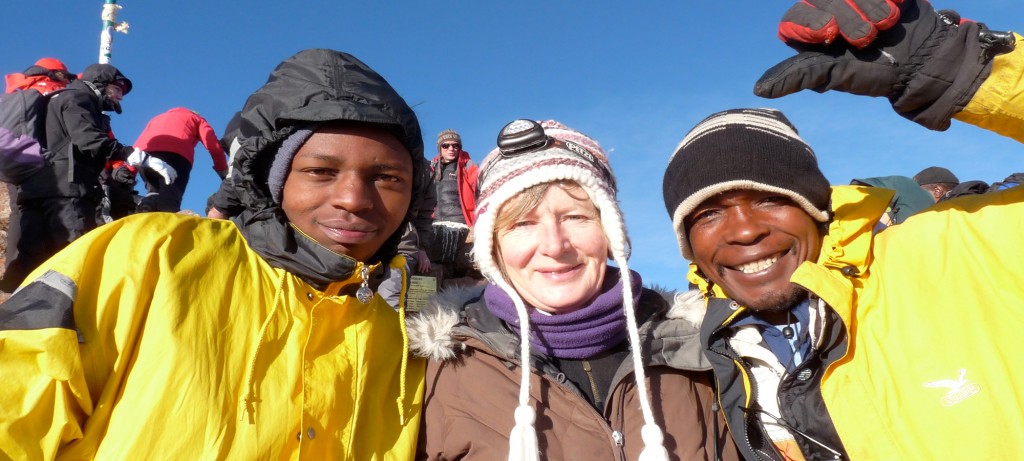
 Article in the Telegraph
It was 2.30am and I could see my breath in the cold air as I struggled to put on thermals in the warmth of my sleeping bag. It was summit day and everyone was nervous, not least because there were a couple of extra guides in case some of us didn’t make it. Outside it was pitch black except for a tiny necklace of lights, the head torches of another group in the far distance. We started walking at the speed of the slowest in our group as a cruel wind whipped around us.
We had begun our ascent of Mount Kenya, the country’s highest mountain, and second highest in Africa (after Kilimanjaro, about 250 miles/400km south), four days before. There are a few classic routes, but we were following the little-used Burguret trail and would return on the Sirimon route. For two days our porters had been hacking back the overgrowth. Added to the huge amount of equipment carried by our 27 porters, cooks and guides for 11 of us, are chainsaws and machetes.
Mount Kenya is an extinct volcano, where glaciers have tumbled over the ancient lava and the peaks are snow capped. The two highest peaks, Batian (17,057ft/5,199m) and Nelion 17,021ft/5,188m), are almost vertical in parts and are classed as technical climbs.
Batian was first climbed by Sir Halford Mackinder, an Englishman, in 1899. Our goal was Point Lenana at 16,350ft (4,985m).
READ THE WHOLE African Ascent – Mount Kenya ARTICLE HERE