
Nicky Holford Dances and Flies Her Way Across Chile
Sometime after midnight, on a cold August night, I am dancing in Chile’s Hotel Portillo 9,350 ft above sea level in the foothills of the Andes, close to the Argentine border. I sip on my pisco sour, as the theme to Top Gun reaches a crescendo, Mario, the helicopter pilot spins me across the floor to the words “Fly me to the Danger Zone”.
Hours later a very different Mario passes me a pair of headphones. The helicopter looks as frail as a dragonfly. It’s interior, having been stripped of all extra weight, is literally a shell. Flying in the Andes constitutes dangerous high altitude conditions. Aconcagua, just one ridge away is the highest mountain in the southern hemisphere. At 22,841 ft (7,021 m) that’s as high as some Himalayan peaks. Helicopters do not usually fly higher than 16,000 feet, (the height of Everest base camp) because there is not enough air for the blades to bite into and to feed the engine.
In the cool, crisp air our instructions are precise. We are told the blades will never stop rotating. When we reach our destination the helicopter will perch as we get out as quickly as possible, crouching low and then huddling on the snow until it has flown off.
A rush of adrenalin pumps through me as the blades start. Time in the air is money. We are pushed inside the helicopter, the vibration is intense, the noise is deafening. Suddenly it reaches a crescendo and we soar off my stomach somersaulting. As we rise high into the Andes, Mario plugs in my co-pilot’s headphones. I hear the soft wooden flute from the Andean pipe music he has on the CD. “Sometimes I fly with the condors,” he said. These giant birds with over ten-foot wingspan soar on the updrafts between the mountains. “They never like the helicopter to be in front so I have to stay back and follow their movements, like a dance.”
Rising up, higher than the other mountains Aconcagua came into view with a light veil of cloud swirling around the summit. Otherwise the sky was perfect, the Andes magnificent and belittling, I almost had to pinch myself.
Too soon Mario descends and perches on a snowy ridge. Clumsily I get out, fall in the deep snow that’s whipped up by wind all around me. I crouch, one leg up to my thigh in windswept snow. The helicopter turns our spot into a raging blizzard as the blades suck up the snow and throw it out, then it’s gone and suddenly there is silence. All you can do is stare and try to take in the view. We are just three in this larger than life landscape; Matt our Canadian guide and believe it or not another Brit from Kew called Neil Armstrong a heli-virgin and snowboarder. We perch on the ridge and decide which line to take. Matt goes and Neil and I feel surprisingly lonely.
It’s my turn and I feel incredibly nervous. Once I push off the exhilaration takes over, I’m skiing in the Andes 13,000 ft high in untracked powder in the Mardones Valley. I can see no one. The gradient is perfect, the powder floating around my knees; I’m in the zone, counting my turns. Just when my legs are buckling there is another whole untouched pitch. I have to go on. Finally when I reach Matt I’ve done 50 turns, I’m panting like a steam engine from the lack of oxygen and my legs are burning. This is worth the hideous journey to South America.
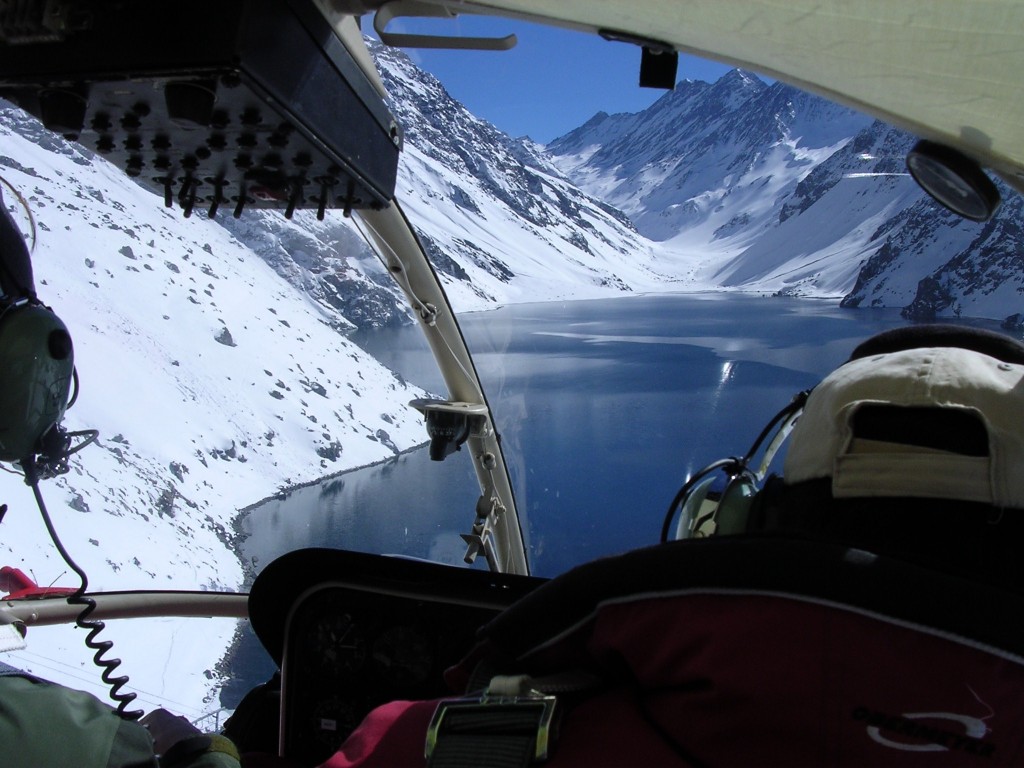
When it’s all over and we’re in the helicopter home, Mario swoops down towards the Laguna del Inca where the silhouette of black mountain peaks are framed in the intense blue water. It is a sight so splendid that has become etched in my mind. The setting is sublime, a bright yellow hotel curved around the lake, with peaks in the distance reaching 19,000 ft in a 360 degree panorama.
Skiing at Hotel Portillo usually starts at a civilised 10.30 am after a breakfast of pancakes with dulce de leche (sweetened milk) and home cooked croissants and chirimoya a fruit cake that tastes of strawberries and apple, in the leather panelled dining room that feels like a private men’s club. There are 800 acres to ski and with only 450 guests at the hotel so there’s never a queue. The ski area is small by European standards but as challenging as you wish, with diehard skiers climbing up steep rocky chutes to access challenging runs such as Kilometro Lanzado where the 200 kph speed record was broken or the classic Super C, an off piste epic run. When it’s cold enough you can ski to the lake and skate across its frozen waters. Or you can cruise gently, and take lunch serious at Tio Bob’s a cosy wooden shack with an open fire and magnificent terrace view.
It’s the oldest ski area in South America and Portillo was put on the map in 1887 when the Chilean government planned to build a railway through the Andes at Uspallata pass to the Argentine city of Mendoza with plans for it to eventually go to Brazil. British engineers were contracted, who in turn hired Norwegians who traversed the area on skis while conducting a feasibility study. The railway opened in 1910 and the Tran Andean Railway became the first ski lift for recreational skiers who used it to get to the top of the mountain at Caracoles. Skiing in Portillo began in the 1930s with a rudimentary tow lift. The government opened a 125 room hotel after the Second World War. Everyone, even guests used to pitch in to groom the slopes but it wasn’t until the ski area was sold to two Americans, Bob Purcell and Dick Alrich in the 1960s that Portillo ever became profitable.
With countless teething problems, including one time when some high profile guests spent their visit to Portillo in a tunnel after an avalanche fell on the line, Henry Purcell decided the only way to put Portillo on the map was to hold the alpine World Championships there. The first and only World Cup to be held in Latin America did eventually take place in 1966 with Jean-Claude Killy winning the gold – but only after a storm a few months earlier had wiped out most of the new lifts. But ever since then the Austrian and American teams have returned to train in the summer. Today you could well find yourself in the hotel bar or outdoor hot tub with the ski racing elite including Hermann Maier, known to tease the US team for using up all their legs by over training.
Now it is the type of family-owned hotel to which guests return year after year, at the same time, in the same room. The Brazilians come in June and the Argentineans in July, but due to an ailing economy some fast thinking marketing has targeted the Americans. I hit singles and Ski with the Superstars week, and at times felt I was in Colorado rather than Chile.
The superstars happen to be some of America’s best known extreme skiers who teach a clinic for the bold and fearless. At the opening session extreme skier Chris Davenport asked the participants to tell everyone a bit about themselves and what they hoped to get out of the week. “I’d like to work on my cornice entry,” was one of the replies – a line I vow to steal one day.
As some of the steeper skiing in Portillo is on potential avalanche routes where it is impossible to have permanent lifts, so there is a unique system called the va et vient which is a five man poma attached to the mountain by a cable that shoots skiers up to the top. It’s feels rather like water skiing and requires nerve and concentration. Thundering up the Roca Jack, the steepest va et vient lift, I’m speechless when my American neighbour asks: “Do you foxhunt?”
A few days earlier I had been driven up the harrowing, twisty road to Chile’s largest resort Valle Nevado. It’s the closest international ski resort to a capital city – just 64 kilometres from Santiago. The sky was cobalt blue and I saw no hint of the pollution that blights Santiago, just the awesome sight of dark hills replaced by white mountains in the distance. We stopped once to watch the condors surfing on the thermals and gaze at Aconcagua in the distance. We talked earthquakes (Santiago is due a big one) and politics. Claudio, my driver worked with Sergio who used to be Pinochet’s driver.
Known as Chile’s Three Valleys, Valle Nevado comprises the resorts of La Parva and El Colorado. Europeans can understandably be a little disappointed to travel half way around the world to find themselves at a purpose-built resort with angled high rises, concrete terraces and wood-cladding, seemingly identical to Les Menuires in France’s Trois Vallees. The influence no doubt rubbed off on its Chilean architect, Eduardo Stern who worked in Les Arcs in the late 1980s. There are three hotels graded three, four and five star.
If you want character, visit the village of Farellones where you could stay in a hotel owned by a former horse hustler. This village is connected by road to La Parva a collection of colourful apartments owned by wealthy Chileans, and El Colorado a less chic resort but with bars and restaurants that offer alpine familiarities such as fondues and raclettes.
For convenience and quick access to the most extensive skiing in Chile, Valle Nevado has all mod cons, state of the art lifts and a dazzling array of top restaurants such as La Forchette d’Or (turbot that melts in your mouth), Don Giovanni (memorable risotto) and Sushiyama (fresh and flavourful sushi). With so many coastlines the fish in Chile is a discovery in itself. Service, ambience and comfortable sofas in the bars and restaurants make up for aesthetics.
On my first morning I looked outside my cathedral window to see layer after layer of meringue. Towering above these folds of unblemished ski slopes were jagged peaks stretching into the skyline, dominated by the highest mountain, El Plomo 5,430 m that the Incas used to climb to offer sacrifices.
Being only a two hour drive from Santiago, Valle Nevado gets busy at weekends. A day trip is feasible from the city and everything can be rented, ski clothes, equipment, cars with chains. The resort is geared up for a international clientele with packages that include everything from tango demonstrations, wine tasting to sports facilities that offer aerobics, yoga, stretch classes and even football. Meals at the various restaurants and lift passes are also included. Spa treatments are extra, so is a hit of oxygen. Valle Nevado is higher than any resort in Europe and a short inhalation of pure oxygen (£10 a shot) is as popular as bottled water.
Jesus, who is head of the ski school arranged for me to be shown around the 100 km of pistes and 42 lifts. It was mid-week, and apart from the Canadian and German ski teams training there seemed to be few people around. The three ski areas are linked, but the “package” lift pass does not cover them all and a small fee is payable for both La Parva and El Colorado.
Eventually my Chilean guide Sebastien and I set off keeping high and crossing the Olympic Valley to get to El Colorado. The off piste is unlimited, miles and miles of untracked snow. At La Parva we had lunch in a small wooden bar and restaurant with a roaring fire called Gatronomia Provence and tucked into tortillas and some Chilean wine. With an abundance of wineries nearby Chileans treat wine drinking almost as a national passion.
When we left the weather had changed, a thick blanket of fog obscured La Parva and we had to take a couple of lifts to emerge from the clouds. We ventured off piste where the snow was “cartona” (meaning cruddy and crusty). Soon there were no lifts in sight as we picked our way through long gullies and over the ridge back to the Valle del Inca and home. Unlike Europe where heli-skiing is regulated and not allowed at all in some countries such as France, the heli-skiing in Valle Nevado is extensive with long vertical drops and stunning scenery. But one needs to get in there quickly. When I was visiting the helicopter had been booked every day for a month by a US talk show host who has been visiting for years.